OpinionAI AdoptionGetting Started
Your biggest AI risk sits at a desk
AI risk is less an IT problem than a people one. Hallucinations, data leaks and agentic AI all start with how employees use the tools.

Simon Bransfield-Garth
Chief Technology Officer
- Published
- Last reviewed

As AI becomes more prevalent in business, regulators and governments are becoming increasingly interested in how AI is controlled and managed. Many businesses view this as an IT problem, rather like cybersecurity but the reality is, like cars, the biggest risk is the person in the driving seat.
Many companies have provided AI technology widely to employees (for example Microsoft Copilot) and encouraged its use. In parallel, entrepreneurial employees are using their own private AI like ChatGPT as a way of getting things done. In a personal environment, that is fine. You cannot come to too much harm asking an AI how to make the best Sunday roast. Even if the AI gets it wrong, common sense will rapidly intervene.
In business it is a bit different. An employee uploads a draft of the monthly departmental report and that information goes somewhere. Exactly what happens to it and how it is used is not something an individual is likely to know or even think about. Which country is the server in? Will the data be used for model training and therefore potentially be available when other people search for the same information? There are many examples of pitch decks, confidential company records or private health information being accessible from mainstream AIs.
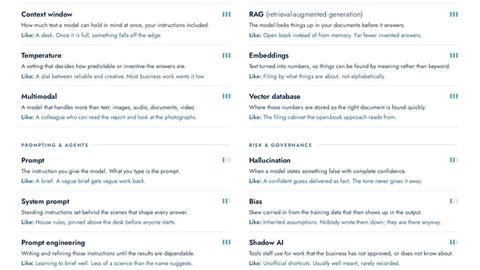
The problem also occurs when the AI responds. Ask AI how to engage 5th reverse gear on a 2017 Toyota Land Cruiser and some will tell you, even though no such thing exists. That is known as “hallucination” and is where the AI makes a guess because it does not have adequate training information to provide a precise answer. Again, in this case, common sense takes over and the error is obvious. But what if it’s a reference to a conference that did not happen or an article that does not exist. Nobody is going to immediately know which of the provided references is correct and which is not.
And this problem is about to get worse with the increasing use of so-called “Agentic AI”. These are AI tasks where you don’t simply ask the AI to do one job but you ask it to follow a process to get some things done. For example, you might ask an AI to “evaluate the UK market for commercial cleaning supplies and rank the competitive strengths and weaknesses of the different suppliers”. Imagine the AI hallucinates a supplier XYZ company, a £20m turnover business operating out of Birmingham. Now you ask the AI to write a competitive marketing campaign. It will take the incorrect information it has hallucinated and build you a coherent and fully believable plan for competing with XYZ company. The plan looks great, just as if it has come from an MBA student or a major consultancy. It goes to the Board for approval. The logic is flawless and compelling. But it’s all nonsense.
The point here is, like the car, you cannot simply blame the AI. It is what it is. But in many businesses, it has been rolled out without any training or deep awareness of its limitations. It’s like giving every teenager a new Ferrari without even saying “be careful how you drive it”.
The AI genie is out of the bottle and there is no opportunity to put it back. The only course of action as businesses is to make sure the people using it understand what they should and should not do.
- Which AI tools are allowed in the business?
- What data can you put into an AI and what must never go there?
- How do you know if what the AI is telling you is real or just made up?
This is a combination of policies and training and is something all businesses, big and small, should be considering. Ironically, AI is often used by people specifically because they lack the skills to do the same job themselves. The problem is, if you don’t know what is happening, you probably won’t spot when it goes wrong, but instead simply pass the information up the chain as if it was fact.
In practical terms, what does this mean for UK businesses?
First, consider putting in place some rules and employee training, just like you will already have done for data privacy. Regulation is already here in the form of data protection law, regulators such as the ICO and FCA are applying their existing rules to AI, and more is on the way. It makes sense to get ahead of the game.
Secondly, someone in the business needs to be formally tasked with AI Governance, reporting to the CEO or the Board. It might be the CFO, the head of IT or the operations manager. But that person needs a name and a mandate to get things done.
The good news is there are increasingly tools and support to help you do this. Putting in place a basic process, with some consultant support, is less than a week of work. And maintaining it is perhaps 1-2 days per quarter. Non-zero but hardly a showstopper.