ResearchAI AdoptionBuilding Capability
Private AI: the business case for running your own AI infrastructure
Should your firm run its own AI? A UK-first report on private AI: open-weight models, hardware, real costs, data protection, security and a practical decision framework.

Isaac Ward
AI Practitioner
- Last reviewed
Key findings
- Open-weight models now trail the best closed models by about four months on broad measures, though the gap is wider on the hardest tasks and on private test sets.
- A single GPU or high-memory workstation can now serve a capable 20–120 billion parameter model to a small team.
- On cost alone, hosted APIs usually beat self-hosting at SME volumes once people costs are included.
- The strongest case for running your own AI is control: of confidential data, of costs and of vendor dependency.
- Self-hosting moves security risk rather than removing it: researchers found 175,108 Ollama servers exposed on the public internet in early 2026.
- UK regulators are technology-neutral, but the FCA now highlights firms that made considered, evidenced decisions about where their AI runs.
Method: Desk research completed in November 2026, drawing on 73 sources: UK regulators and official statistics (FCA, ICO, SRA, ONS, DESNZ), EU legislation, independent benchmarks (Stanford HAI, Epoch AI, Artificial Analysis), academic research and primary vendor documentation. Vendor-sponsored data is flagged. Cost figures are illustrative, with assumptions stated.
Most firms now use AI. Very few control it. Every prompt sent to a public chatbot or cloud API leaves your network, lands on someone else’s servers and is governed by someone else’s terms. For many tasks that is fine. For client files, privileged documents, financial records and personal data, a growing number of firms are asking a harder question: should we run our own AI?
This report sets out what “private AI” actually means, what it costs, what UK law and regulators expect, where the risks are, and whether a 50 to 250 person firm can realistically do it. It is written for leaders deciding whether to invest and for the practitioners who would have to make it work.
How to read this report
- Leaders: start with the executive summary, then sections 1, 6 and 10, the key takeaways and the recommendations.
- Practitioners: sections 3, 4, 5, 7, 8 and 11 carry the technical, compliance and implementation detail.
- Sources: facts carry a numbered source in square brackets, for example [1]. The full list, with links and dates, is at the end.
- Fact, view and advice: text marked “Our view” is TURMA’s interpretation of the evidence. Text marked “Recommendation” is advice. Everything else is reported fact.
- Currency: prices, model rankings and hardware figures are correct as of early November 2026. This market moves fast, so recheck them before you budget.
Executive summary
Private AI is a spectrum, not a product. It runs from a business chatbot with strong contractual protections, through private cloud endpoints in a UK region, to open-weight models on servers you own. The right point on that spectrum depends on your data, your volumes and your skills.
The capability gap has narrowed sharply. On Stanford’s 2026 AI Index, the best closed model led the best open model by just 3.3% in March 2026 [1]. Epoch AI estimates open-weight models trail the frontier by about four months [2]. The gap is wider on the hardest tasks and on newer, private test sets [6][7], so “nearly as good” holds for routine work, not for everything.
Capable models now fit on practical hardware. OpenAI’s gpt-oss-120b runs on a single 80 GB GPU, and its 20B sibling within 16 GB of memory [9]. Google’s Gemma 4 family ships under the permissive Apache 2.0 licence [10]. One workstation can now serve a capable model to a small team.
On cost alone, self-hosting rarely wins for smaller firms. Hosted versions of open-weight models cost cents per million tokens [31]. In our illustrative model, a single-GPU server only matches a frontier API at around 235 million tokens a month once staff time is counted, and would need billions of tokens a month to match a budget API (section 6). Academic break-even estimates look kinder, but they leave out people, security and maintenance [27].
The real case is control. Running a model yourself keeps sensitive data inside your perimeter, reduces dependence on one vendor’s pricing and terms, and can be easier to evidence to clients and regulators. That is why HSBC is self-hosting Mistral’s models [65] and why Latham & Watkins has bought its own NVIDIA servers [66].
Running it yourself moves risk; it does not remove it. Researchers found 175,108 Ollama servers reachable on the public internet in early 2026 [52]. Malicious models have been found on public model hubs [56][57]. Self-hosting makes you responsible for security that a cloud provider would otherwise handle.
Regulators are technology-neutral. UK GDPR, the FCA and the SRA care about control, confidentiality and evidence, wherever a model runs. The FCA’s October 2026 good-practice review highlights firms that made considered decisions about where to host their AI [40].
The short answer for most 50–250 person firms:
- Get visibility first: know what AI is in use and what data goes into it.
- Give staff a private “front door” to commercial models, with UK data residency and no-training terms, for general work.
- Self-host selectively, for narrow, high-sensitivity or high-volume workloads, after piloting on rented infrastructure.
- Do not train your own model from scratch.
1. What “private AI” actually means
“Private AI” is as much a marketing term as a technical one. Vendors use it for everything from a chatbot with a no-training clause to an air-gapped server in a locked room. A useful working definition: AI where your organisation controls where data is processed, who can access it and which model processes it.
Three ideas are often blurred together:
- Data residency: where data is physically stored and processed, for example in a UK data centre.
- Data sovereignty: which country’s laws can reach that data, and who can be compelled to hand it over. A UK data centre run by a US company may still be within reach of US law [36].
- Operational control: who runs the system day to day, applies updates and can see the logs.
Private AI raises your control over some or all of these. It does not automatically raise all three.
The private AI spectrum
It helps to think in six levels. Control, cost and effort all rise as you move down the list.
- Level 1: consumer AI tools. Free or personal accounts of public chatbots, used under consumer terms that may allow training on your inputs. Least control, and the usual source of shadow AI.
- Level 2: business subscriptions and APIs. Enterprise plans with contractual protections such as no training on your data, retention limits and admin controls. Data still goes to the provider, often outside the UK unless residency is offered.
- Level 3: private cloud endpoints. Commercial or open models served from a cloud provider’s UK region over private networking. Strong residency and contractual control for low effort. Sovereignty depends on the provider’s jurisdiction.
- Level 4: dedicated hosting of open-weight models. A model you choose runs on GPUs reserved for you, rented from a cloud or GPU provider, ideally UK-based. You control the model and its configuration; the provider runs the hardware.
- Level 5: self-hosted on your own servers. Open-weight models on hardware you own, in your office or in rented data centre space. Maximum control and maximum responsibility.
- Level 6: on-device or air-gapped. Models on laptops, phones or isolated machines with no internet connection. Right for the most sensitive material, but limited in model size and hard to manage at scale.
Our view: most of the benefit for most firms sits at levels 2 to 4. Levels 5 and 6 make sense for specific, well-defined workloads rather than as a firm-wide default.
Open weights are not the same as open source
Most “open” models are open-weight: you can download the trained parameters and run them yourself, but the training data and code are not released. The Open Source Initiative’s Open Source AI Definition asks for much more: detailed information about the training data, the full training code and the parameters, all under open terms [15]. Very few popular models meet that bar.
In practice, what matters is the licence. Three broad types are common in late 2026:
- Permissive licences such as Apache 2.0 and MIT, with few restrictions on commercial use. OpenAI’s gpt-oss models and Google’s Gemma 4 use Apache 2.0 [9][10].
- Custom open-weight licences, free for most users but with conditions. Meta’s Muse Model License allows commercial use up to a revenue threshold and requires “Built with” attribution [11]. Mistral released Large 4 under a modified MIT licence with extra conditions [13].
- Research or non-commercial licences, fine for experiments but not for client work.
Recommendation: have someone read the licence before a model touches production. Check commercial use, attribution, revenue or user thresholds, acceptable use terms, and whether you may fine-tune and redistribute.
2. Why private AI is on the agenda now
Four forces have moved private AI from a niche concern to a board-level question in 2026.
Open models have mostly caught up
In 2023 open models were often dismissed as a year or more behind. For most business tasks that is no longer true. Stanford’s 2026 AI Index found the top closed model led the top open model by 3.3% in March 2026, up from just 0.5% in August 2024, with six of the top ten models on the Arena leaderboard closed [1]. Epoch AI’s capability index puts the average lag at about four months since January 2026, slightly up from three months across 2023 to 2025 [2][3].
The answer depends on how you measure. In April 2026 Artificial Analysis found the best open-weight models within 3 to 6 points of the leaders on its intelligence index, against about 13 points a year earlier [5]. When it rebuilt the index in October 2026 around private, unseen test sets, the gap to the best open-weight model widened from 3 points to 12, and models whose weights could actually be downloaded trailed the leader by 26 points [6][7]. Epoch AI has made the same warning: public benchmarks may flatter open models, so the real-world gap is likely longer than headline figures suggest [4].
Our view: for drafting, summarising, extraction, classification and search over your own documents, current open-weight models are good enough for most firms. For the hardest reasoning, complex agentic work and long multi-step tasks, frontier closed models still lead. Plan for both.
Small models got much better
Capability that once needed a data centre now fits on a desk. Epoch AI found that open models small enough to run on a single consumer GPU match the frontier of six to twelve months earlier [4]. Gartner predicts that by 2027 organisations will use small, task-specific AI models at least three times more than general-purpose large language models [16].
Confidentiality and sovereignty pressure
Clients, insurers and regulators increasingly ask where data goes. In 2023 Samsung banned staff from using public AI tools after engineers uploaded source code to ChatGPT [58]. In 2025 Microsoft France’s legal director told a French Senate inquiry, under oath, that he could not guarantee European customer data would never be handed to US authorities [36]. In August 2026 the SRA warned solicitors that putting client information into AI tools without proper safeguards may breach confidentiality [44].
Cost, pricing and dependency
Usage-based AI pricing is hard to forecast, and reliance on a single provider is a strategic risk. Latham & Watkins cited rising consumption-based pricing, and the wish to avoid depending on one provider, when it bought its own servers [66]. The FCA now lists over-dependence on a specific AI model or third party as a risk firms should actively manage [40].
What organisations are actually doing
- UK adoption is wide but shallow. 38% of UK businesses with 10 or more employees used at least one AI technology in September 2026, up from 12% in September 2023 [69]. The average adopter uses 1.6 AI technologies [68].
- Large enterprises are moving inference in-house. In Broadcom’s 2026 survey of 1,800 IT leaders, 56% were running or planning production AI inference on private cloud, against 41% on public cloud [70]. Broadcom sells private cloud software, so treat this as directional.
- Repatriation is a live topic. Research sponsored by storage vendor Cloudian found 93% of enterprises had moved, were moving or were evaluating moving AI workloads off public cloud [71].
- But enterprises still prefer closed models. Menlo Ventures, an investor in Anthropic, reported that open-source models’ share of enterprise LLM workloads fell from 19% to 13% in the first half of 2025 [72].
Our view: these signals look contradictory but fit together. Larger organisations are changing where AI runs, towards private infrastructure and private endpoints, faster than they are changing which models they use. The direction of travel is hybrid, not a wholesale move to self-hosting.
3. The open-weight model landscape in late 2026
The open-weight market has split into two tiers. Knowing which tier your work needs is the most important hardware decision you will make.
The frontier tier: powerful, but data-centre scale
The strongest open-weight models are now very large mixture-of-experts (MoE) systems with hundreds of billions to trillions of parameters. Meta’s Muse Spark Open, released in October 2026, has 816 billion parameters [12]. Mistral Large 4, whose weights followed on 29 October 2026, has around a trillion [13]. Running a model of that size yourself needs an eight-GPU server or more [14]. In April 2026 the top ten open-weight models on Artificial Analysis’s index all came from China-based labs [5].
For most smaller firms, frontier-tier open models are something to use through a hosted API or a dedicated cloud deployment, not to run in-house.
The practical tier: fits on one machine
Below the frontier sits a crowded tier of models that run on a single GPU or a high-memory workstation and handle most business tasks well. Examples include:
- gpt-oss-120b and gpt-oss-20b (OpenAI, Apache 2.0). The 120B model runs on a single 80 GB GPU; the 20B model within 16 GB of memory [9].
- Gemma 4 (Google, Apache 2.0). Sizes from small edge models up to a 26B MoE and a 31B model [10].
- Nemotron (NVIDIA). The family Latham & Watkins is fine-tuning in-house [66].
- Other families, including Qwen and Mistral’s smaller models, offer 20–40B options. Licence terms vary by model and version, so check each one.
A note on mixture-of-experts: an MoE model activates only a fraction of its parameters for each token. gpt-oss-120b has about 117 billion parameters but uses about 5 billion per token [9]. That makes it much faster than its size suggests, although you still need enough memory to hold all of it.
Supply and provenance risk
Open-weight availability is not guaranteed. Some Chinese labs moved their newest flagship models to closed, hosted offerings in 2026 [8], while Meta, Google and Mistral have released more open weights [10][11][13]. Provenance matters too: when you run a model, you are trusting its developer’s training data, safety tuning and any embedded behaviour.
Recommendation: prefer permissively licensed models from developers who publish model cards, test them on your own data, and design your system so the model can be swapped without rebuilding everything.
How to choose a model: a checklist
- Licence: commercial use allowed, conditions acceptable, fine-tuning permitted.
- Fit: runs on hardware you can afford, with room for long documents and simultaneous users.
- Task quality: tested on 50–200 real examples from your own work, not just public benchmarks.
- Language and domain: handles UK English, your sector’s terminology and the document formats you use.
- Context length: long enough for your documents, tested at the lengths you will actually use.
- Tool use: reliable structured outputs and function calling if you plan workflows or agents.
- Safety behaviour: acceptable refusal, hallucination and prompt-injection results on your test set.
- Provenance and support: a published model card, active maintenance and a community or vendor that ships fixes.
4. Hardware: what you actually need
Two numbers decide what you can run and how fast: memory capacity and memory bandwidth. Raw compute matters less than most spec sheets suggest.
Memory capacity: will the model fit?
A model’s weights need roughly its parameter count multiplied by the bytes stored per parameter: 2 bytes at 16-bit precision, 1 byte at 8-bit and about half a byte at 4-bit. Storing weights at lower precision, called quantisation, saves memory at a modest cost in quality that you should test. As a guide:
- An 8B model needs about 16 GB at 16-bit, or about 4 GB at 4-bit.
- A 31B model needs about 62 GB at 16-bit, or about 16 GB at 4-bit.
- A 70B model needs about 140 GB at 16-bit, or about 35 GB at 4-bit.
- A 1-trillion-parameter model needs about 500 GB even at 4-bit.
On top of the weights, the model needs working memory for each conversation, known as the key-value (KV) cache. It grows with document length and the number of simultaneous users, and for long contexts or busy systems it can rival the weights themselves [25]. Leave at least 20–30% headroom and test with your real document lengths.
Memory bandwidth: will it be fast enough?
When a model writes, each new token requires reading its active weights from memory, so generation speed is limited by memory bandwidth rather than raw compute [25]. A rough ceiling for one user is the bandwidth divided by the bytes read per token. For a 31B dense model at 4-bit, that is about 18 tokens a second on a machine with 273 GB/s of bandwidth, and about 116 on a GPU with 1,792 GB/s. Real speeds are lower, and simultaneous users share the bandwidth.
MoE models change the maths. Because gpt-oss-120b reads only about 5 billion parameters per token, the same 273 GB/s machine has a theoretical ceiling of about 100 tokens a second for it.
Hardware tiers for smaller firms
Prices are list or typical retail prices in late 2026. Several are US list prices; UK prices are usually higher once VAT and import costs are added.
- Tier 0: existing laptops (16–64 GB). Small models (4–14B) for individual experiments with tools such as LM Studio or Ollama. No new spend, but not suitable for client work without proper controls.
- Tier 1: AI desktops (up to 128 GB). NVIDIA’s DGX Spark has 128 GB of unified memory but only 273 GB/s of bandwidth; its price has risen from $3,999 at launch to $6,950, with a 64 GB version at $4,999 [17]. Apple’s Mac Studio with M5 Max offers up to 128 GB at 614 GB/s from $2,499 [18]. Good for development, pilots and a handful of users.
- Tier 2: team servers (96–512 GB). A workstation with an NVIDIA RTX PRO 6000 Blackwell (96 GB, 1,792 GB/s), a card whose UK price ranged from about £6,700 to £15,000 over the past year [21], or a Mac Studio with M5 Ultra (up to 512 GB at 1.2 TB/s, from $5,499 and up to $29,799 fully loaded) [18][19]. Can serve a 20–120B model to a team.
- Tier 3: data-centre GPUs, rented or owned. NVIDIA H100 (80 GB) and H200 (141 GB) class. In October 2026, median on-demand prices across GPU clouds were about $4.20 an hour for an H100, $5.70 for an H200 and $8.19 for a B200, with hyperscalers charging more [22]. Other indices put specialist-cloud H100 rates nearer $2.82 an hour; buying an H100 outright costs roughly $25,000–$40,000 [23].
- Tier 4: multi-GPU servers. Eight-GPU systems for trillion-parameter models. Realistically beyond most firms below enterprise scale.
The 2026 memory squeeze
AI hardware has become more expensive, not less, during 2026. Memory shortages pushed the 128 GB DGX Spark to nearly 75% above its launch price [17], and Apple cut memory options on its previous Mac Studio during the shortage [20]. Rental markets tightened too: AWS raised H200 instance prices by 15% in January 2026 [24], and one index recorded a 38% rise in one-year H100 contract prices between October 2025 and March 2026 [22].
Recommendation: build price contingency into any hardware plan, and pilot on rented capacity before you buy.
5. Software and operations: the stack you will run
The model is one component. A usable private AI service needs a small stack around it:
- Inference engine. Runs the model. Ollama, LM Studio and llama.cpp are simple and good for one user; vLLM and SGLang are built to serve many users at once.
- Gateway. One internal API for all models, with authentication, rate limits, logging and the ability to route requests to different models.
- User interface. A chat and document workspace for staff, connected to your identity provider for single sign-on.
- Retrieval. Embeddings and a vector database so the model can answer from your own documents, known as retrieval-augmented generation (RAG).
- Monitoring and logging. Usage, errors, latency and cost, with logs treated as sensitive data.
- Evaluation. A set of real test tasks to check quality whenever you change the model, prompts or settings.
- Update routine. A schedule for patching software and reviewing new model versions.
Single-user tools do not scale to a team
This is one of the most common mistakes. In Red Hat’s benchmark on the same GPU, vLLM peaked at 793 tokens a second under concurrent load, against 41 for an Ollama set-up tuned for parallel requests [26]. Ollama is excellent for experimentation. A shared service needs a serving engine designed for concurrency.
Retrieval first, fine-tuning second, pre-training almost never
Most business value comes from connecting a good model to your own documents through retrieval, not from changing the model. Fine-tuning helps with consistent formats, house style or narrow classification tasks. Training a model from scratch is almost never justified. Bloomberg made a major investment in building BloombergGPT in 2023; within months, researchers found general-purpose ChatGPT and GPT-4 outperformed it on many financial text tasks [60][61].
Skills and the run cost nobody budgets for
Self-hosting is an ongoing service, not a one-off purchase. Someone must patch the stack, watch capacity, evaluate new model releases every few months, manage access and respond to incidents. Latham & Watkins has more than 900 technology specialists [66]. When Travers Smith spun out its AI team, its leader noted how difficult it is to get open-source models live on your own infrastructure [63]. The Department for Business and Trade found that GPU costs rise as usage grows [64].
Recommendation: unless you have in-house engineering capacity, budget for a managed service partner and name an internal owner.
6. The economics: when does running your own AI pay?
How the costs behave
API costs scale with use: twice the tokens, twice the bill. Self-hosting is mostly fixed: you pay for hardware, power and people whether the model is busy or idle, so your cost per token depends on how fully you use the capacity you have bought. One 2026 industry analysis found effective self-hosted costs ranging from $0.21 to $15.25 per million tokens depending on utilisation, and concluded there is no universal break-even point [28].
Today’s price points
- Frontier APIs: flagship models from the leading labs were priced at about $2–5 per million input tokens and $6–30 per million output tokens in mid-2026 [31].
- Hosted open-weight models: as little as $0.04–0.15 per million input tokens and $0.17–0.60 per million output tokens from serverless providers [31].
- Falling fast: the price of reaching a given level of capability has fallen between 9 and 900 times a year depending on the task, with a median of about 50 times [29]. Analysis focused on frontier models suggests a slower 5 to 10 times a year [30].
Falling prices are a moving target for any hardware business case. A server bought today competes with API prices in two years’ time.
What the research says about break-even
The most detailed academic study, by Carnegie Mellon researchers, modelled 54 scenarios. Small open models paid back their hardware within 0.3 to 3 months compared with commercial APIs; medium models of 70–120B in 3.8 to 34 months; and large models in 3.5 to 69 months [27]. The authors conclude self-hosting is viable mainly for organisations processing at least 50 million tokens a month or facing strict data residency requirements. Crucially, the model counts hardware and electricity only, not staff, maintenance, security or compliance [27].
A worked example
To show how assumptions drive the answer, here is an illustrative comparison for a professional services firm. It is a model, not a quote: change the inputs to fit your situation.
Assumptions
- Three input tokens for every output token, the weighting convention used by Epoch AI [29].
- An exchange rate of $1.30 to £1.
- Three API price points: frontier ($5 in, $25 out per million tokens), mid-tier ($1.50 in, $9 out) and budget hosted open-weight ($0.10 in, $0.40 out).
- One self-hosted workstation with a 96 GB GPU at £18,000 all-in, written off over three years: £500 a month.
- An average power draw of 0.5 kW around the clock at 28.76p per kWh, the Q1 2026 average for small UK businesses [32]: about £105 a month.
- Two days a month of skilled support at £600 a day: £1,200 a month.
That puts the self-hosted service at about £1,805 a month, or £605 if you ignore people. How much usage is realistic? Forty active users making 20 requests a day of about 4,000 tokens each (retrieval adds a lot of context) comes to about 67 million tokens a month.
Results
- At 10 million tokens a month, a frontier API costs about £77, a mid-tier API about £26 and a budget API about £1.
- At 50 million tokens: about £385, £130 and £7.
- At 250 million tokens: about £1,923, £649 and £34.
- Self-hosting matches the frontier API at about 235 million tokens a month with people costs included, or about 79 million without them.
- Against the mid-tier API, break-even is about 695 million tokens a month. Against the budget API it runs into billions.
Renting instead of buying changes little at this scale. One H100 running around the clock costs roughly £1,600–£2,400 a month at $2.80–$4.20 an hour, before support [22][23].
Our view: three lessons follow. First, people costs dominate: leave them out and you overstate the savings about threefold. Second, the fair comparison for a self-hosted open model is the same model through a hosted API, and on cost alone the API wins at SME volumes. Third, self-hosting can undercut frontier APIs at high, steady volumes, but only by accepting a less capable model for those tasks.
Costs that business cases miss
- People: administration, security, evaluation and holiday cover.
- Resilience: a single server is a single point of failure. A second unit or a cloud fallback adds cost.
- Refresh: hardware and models move quickly. Plan on a three-year life at most.
- Facilities: power, cooling, noise and physical security if hardware sits in the office.
- Compliance: DPIA, policy updates, supplier assessments for any managed service, and audit evidence.
- Opportunity cost: engineering time spent running infrastructure is not spent improving the workflows that create value.
Value that business cases miss
- Control: you decide which model runs, when it changes and who sees the logs.
- Predictability: fixed monthly costs instead of usage-based bills.
- Confidentiality: some clients and matters simply cannot go to a third party.
- Resilience to outages: local processing keeps working when an internet link or provider fails.
- Leverage: a credible alternative strengthens your hand with commercial AI vendors.
7. Data protection, sovereignty and regulation
No UK law requires you to self-host AI. Several shape the decision.
UK GDPR and the Data (Use and Access) Act
UK data protection law is technology-neutral. If personal data goes into an AI system, you need a lawful basis, transparency, data minimisation, accuracy, security and respect for individuals’ rights, wherever the model runs. The ICO’s guidance on AI and data protection explains how these apply across the AI lifecycle [33]. The Data (Use and Access) Act 2025 received Royal Assent on 19 June 2025, and its data protection provisions are now in force [33]. The ICO’s plans for 2026/27 include a statutory code of practice on AI and automated decision-making [34], and its updated guidance on international transfers sets out a three-step test for identifying restricted transfers [35].
Self-hosting changes who processes the data, not whether the rules apply. It can simplify supplier due diligence and transfer questions. It also makes you fully responsible for security, for how long prompts and logs are kept, and for handling access and deletion requests that touch AI records.
Recommendation: treat prompts, outputs and logs as personal data where they contain it, and complete a data protection impact assessment (DPIA) before any AI system processes personal data at scale.
Sovereignty is about jurisdiction, not just location
Keeping data in a UK data centre does not settle who can access it. US law can compel US-headquartered providers to produce data they control wherever it is stored, which is why Microsoft France could not give the French Senate a guarantee [36]. UK options are widening: OpenAI introduced UK data residency for its API platform, ChatGPT Enterprise and ChatGPT Edu in October 2025 [37], and the Stargate UK partnership with NVIDIA and Nscale is building sovereign compute capacity [38].
Ask three questions of any AI service: where is the data processed, which jurisdictions can compel access to it, and who operates the system?
Financial services
The FCA is not writing a separate AI rulebook. Existing requirements apply: the Principles for Businesses, the Consumer Duty, SYSC, the Senior Managers and Certification Regime, and operational resilience and outsourcing rules [41]. On 19 October 2026 the FCA published examples of good practice and areas for improvement in firms’ use of AI [39][40]. It says 86% of firms are already using AI [42].
Three points bear directly on private AI. Good-practice firms made considered decisions about whether to host models on company-owned architecture or on third-party cloud GPUs. Firms should build AI dependencies, including third-party models, into operational resilience planning. And they should guard against becoming overly dependent on a specific AI model or provider [40]. In May 2026 the FCA, Bank of England and HM Treasury also asked firms to strengthen cyber resilience against frontier AI threats, including risks from third parties and supply chains [43].
Our view: self-hosting can reduce third-party concentration risk, but it creates an important dependency that you operate yourself. Test its resilience like any other critical system.
Legal services
In August 2026 the SRA issued a warning notice on AI misuse after receiving 42 reports of potential AI-related wrongdoing in the year to July 2026 [44]. It says client information should only go into AI systems with appropriate contractual, technical and organisational safeguards, and that firms should satisfy themselves that client data stays in a secure environment and is not used to train AI models unless explicitly authorised [44][45].
For many legal workloads, a private deployment is the simplest way to evidence those safeguards. It is not the only way: an enterprise service with the right contract and technical controls can also meet the standard.
The EU AI Act, if you serve EU clients
The EU AI Act can apply to UK firms whose AI outputs are used in the EU. The Digital Omnibus amendments entered into force on 27 July 2026, deferring high-risk obligations for stand-alone systems to 2 December 2027 and for AI in regulated products to 2 August 2028 [46]. Self-hosting does not change your role under the Act. Fine-tuning an open-weight model only makes you a provider of a general-purpose AI model if the modification uses more than a third of the original model’s training compute, a threshold ordinary fine-tuning comes nowhere near [47]. For the wider picture, read The EU AI Act after the Omnibus: what’s changed for UK firms.
Security standards to align with
- The UK’s AI Cyber Security Code of Practice, published in January 2025 and developed with input from the NCSC [48][49].
- ETSI EN 304 223, the European standard that grew out of the UK code, setting 13 principles across five lifecycle phases from secure design to secure end of life [49][50].
- The OWASP Top 10 for LLM Applications, a practical list of risks such as prompt injection, sensitive information disclosure and supply chain compromise [51].
8. Security: running it yourself moves the risk
A cloud provider handles a great deal of security you never see. When you self-host, that work becomes yours.
Exposed servers
Ollama, one of the most popular tools for running models locally, listens only on the local machine by default; exposing it to a network takes a configuration change [54]. Even so, SentinelOne and Censys recorded 175,108 unique Ollama hosts reachable on the public internet across 130 countries over 293 days of scanning [52][54]. Researchers also described a criminal operation that scans for exposed AI endpoints, validates them and resells access. This is a form of LLMjacking, where criminals use your AI infrastructure and you pay the bill [53]. Cisco had found more than 1,100 exposed Ollama servers in 2025 [55]. Counts vary with method, but the direction is clear.
Model supply chain
Model files can carry malicious code. Older PyTorch formats use Python’s pickle mechanism, which can execute code when a model is loaded. JFrog researchers found around 100 malicious model repositories on Hugging Face, and Protect AI, working with Hugging Face, had scanned more than four million models and flagged around 352,000 unsafe or suspicious findings [56]. In 2025, ReversingLabs found models that used deliberately broken pickle files to slip past Hugging Face’s scanner [57].
Application risks
Private models face the same application risks as public ones. Prompt injection, where text hidden in a document, email or web page hijacks the model’s instructions, tops OWASP’s list [51]. The risk grows when a model can call tools, send messages or change records. Self-hosting does not fix it; careful design does.
Security checklist for self-hosted AI
- Never expose model servers directly to the internet. Bind them to localhost or a private network and put an authenticated gateway in front.
- Use single sign-on and role-based access, and restrict who can reach which models and document collections.
- Download models only from verified publishers, prefer the safetensors format, check file hashes and scan files before loading.
- Patch the inference engine, interface and dependencies on a schedule, and subscribe to their security advisories.
- Log prompts, outputs and admin actions to a protected store, with retention set by your DPIA.
- Limit what agents and tools can do: least privilege, human approval for consequential actions, and rate and spending limits.
- Test for prompt injection and misuse before launch and after major changes.
- Include the AI stack in your incident response plan, backups and penetration tests.
If something does go wrong, our guide What to do after an AI-related data incident sets out the first steps.
9. Case studies
These examples are drawn from public sources. Together they show why organisations go private, how they do it and what goes wrong.
Samsung: the leak that started the conversation (2023)
In April 2023 Samsung engineers uploaded sensitive source code to ChatGPT. Within weeks the company banned generative AI tools on company devices and said it was preparing internal alternatives [58]. In an internal survey, 65% of respondents said such services posed a security risk [59].
Lesson: bans push use underground. Offer a safe, approved alternative at the same time.
BloombergGPT: the cost of building from scratch (2023)
Bloomberg trained a 50-billion-parameter model on a 363-billion-token financial dataset plus 345 billion tokens of general text, and reported strong gains on financial tasks [60]. Within months, researchers found general-purpose ChatGPT and GPT-4 outperformed it on many financial text analytics tasks [61].
Lesson: unless you have unique data, deep pockets and a lasting reason, adapt existing models rather than building your own.
Travers Smith: a private front door (2023)
UK law firm Travers Smith built YCNBot, an internal chatbot that replaced consumer ChatGPT with an interface connected to enterprise AI services from Microsoft and OpenAI, and released it free as open source [62]. The team later spun out as a separate AI company, Jylo [63].
Lesson: the first step towards private AI can be a governed interface over enterprise services, not your own hardware.
Department for Business and Trade: self-hosting in a private cloud (2025)
DBT deployed open-source models, including from the Llama and Mistral families, on its internal data platform using AWS SageMaker inside a private network isolated from the internet [64]. Uses include topic modelling of trade agreements, extracting structured data from long documents and analysing consultation responses. A pilot with 15 users reported no critical issues; the main challenge was GPU cost rising with usage [64].
Lesson: self-hosting does not have to mean owning hardware. A private cloud deployment can deliver most of the control with far less operational burden.
HSBC and Mistral AI: commercial models, self-hosted (2025)
In December 2025 HSBC announced a multi-year partnership giving it access to Mistral AI’s commercial models, including future versions, deployed as self-hosted models on HSBC’s internal technology systems [65].
Lesson: self-hosting and vendor partnerships are not opposites. You can license a model and still run it inside your own perimeter.
Latham & Watkins and Kirkland & Ellis: Big Law builds (2026)
In September 2026 the Financial Times reported that Latham & Watkins had bought several NVIDIA GPU servers, housed in locked data centre space, and was fine-tuning NVIDIA’s open-weight Nemotron 3 models. Its reasons: some client data is too sensitive for cloud vendors, consumption-based pricing is rising, and it wants alternatives to any single provider. It still uses commercial AI tools alongside its own [66]. Separately, Kirkland & Ellis has committed £370 million over three to four years to build its own AI platform, while continuing to invest in third-party tools [67].
Lesson: even the most ambitious firms run hybrid models. Their scale, with more than 900 technologists at Latham, shows what full self-hosting demands.
Exposed servers: when self-hosting goes wrong (2026)
SentinelOne described the 175,000 exposed Ollama hosts it found in early 2026 as an unmanaged layer of AI compute, spread across cloud and home networks and operating outside the guardrails and monitoring that platform providers apply [52][53]. Some were already being abused by criminals [53].
Lesson: unmanaged self-hosting is shadow AI with a GPU attached. Bring it inside your governance before someone else finds it. Our explainer You can’t govern what you can’t see: shadow AI, explained covers where to start.
10. Can a smaller business realistically run its own AI?
Yes, for the right workloads. A 50–250 person firm can run a capable open-weight model for a defined purpose, such as searching and summarising its own documents, on a single server or a dedicated cloud instance. What it usually cannot do is match the breadth of a frontier assistant across every task, or run the largest open models in-house.
Signs private or self-hosted AI fits
- You handle data that clients, contracts or regulators say must not leave your control.
- You have a narrow, repeatable, high-volume task, such as document classification, extraction or first-pass review.
- You need predictable costs, offline operation or low latency.
- You have, or can buy, the skills to run and secure it.
- You want leverage and an exit route from commercial AI vendors.
Signs it does not
- Your main need is general productivity: drafting, email and research across many topics.
- You need frontier-level reasoning or new features as soon as they ship.
- Volumes are low or unpredictable.
- No one would own it day to day.
- You do not yet know what AI is already in use across the firm.
Three realistic patterns
- Pattern A: the private front door. A governed chat and document interface over enterprise AI services with UK residency, no-training terms and single sign-on. Lowest effort, and the right first step for most firms.
- Pattern B: the hybrid router. A gateway that sends sensitive or high-volume work to an open-weight model you control, in a UK cloud or on your own server, and everything else to frontier services. Most of the control without most of the cost.
- Pattern C: the sovereign appliance. A dedicated on-premises server for one high-sensitivity workflow, such as privileged document review or client file search, often run by a managed service partner.
A decision framework
Score each question 0 (no), 1 (partly) or 2 (strongly yes). A total of 10 or more suggests patterns B or C are worth piloting. Between 6 and 9, pilot pattern B on rented infrastructure before committing. Below 6, pattern A is likely enough for now.
- Does a meaningful share of your intended AI use involve data you cannot send to third parties?
- Do clients, contracts, insurers or regulators ask for evidence of where AI processing happens?
- Is there a specific task with steady volumes above roughly 50–100 million tokens a month?
- Would a model a step behind the frontier do that task well enough?
- Do you need offline operation, low latency or fixed costs?
- Do you have, or will you fund, the skills to run and secure it?
- Is dependence on one AI vendor a material business risk for you?
- Can you name an accountable owner and a budget for at least three years?
Our view: treat this as a conversation aid, not a formula. A strong yes to question 1 can justify a narrow private deployment on its own.
11. A step-by-step implementation roadmap
- See what you have (weeks 1–3). Inventory the AI already in use, including features inside existing software and anything staff run locally. Classify the data involved.
- Pick the use cases (weeks 2–4). Choose one or two specific workflows. Define what good looks like and how you will measure it.
- Build an evaluation set (weeks 3–5). Collect 50–200 real, anonymised examples with expected answers. It will be the most valuable asset you create.
- Pilot on rented infrastructure (weeks 4–10). Test candidate models on a private cloud endpoint or a rented GPU. Measure quality, speed, real token volumes and peak concurrency.
- Decide build, buy or hybrid (around week 10). Run the cost model with your measured volumes and full people costs, and compare it with the hosted version of the same model.
- Complete the paperwork before go-live. DPIA, updated AI use policy, licence review, supplier assessments, security testing and an incident plan.
- Launch small, with guardrails. A limited user group, single sign-on, logging and clear guidance on what may and may not go in.
- Run it as a service. Monthly capacity and cost review, quarterly re-evaluation against new models, scheduled patching and an annual check on whether self-hosting still beats the alternatives.
Pre-launch checklist
- Accountable owner and budget agreed
- Model licence reviewed and recorded
- DPIA complete and lawful basis recorded
- AI use policy updated to cover the private service
- Model files from verified sources, with hashes checked
- No direct internet exposure; authenticated gateway in place
- Single sign-on and role-based access configured
- Logging, retention and monitoring live
- Prompt-injection and misuse testing passed
- Evaluation results meet the agreed thresholds
- Fallback ready if the server fails
- Staff briefed and trained
- Service recorded in your AI register
12. Common mistakes and misconceptions
- “Self-hosted means compliant.” Compliance comes from a lawful basis, security, transparency and evidence. Location helps; it does not replace them.
- “Open source means free.” The licence may be free. Hardware, power and people are not.
- “Local means private.” Exposed servers, unprotected logs and over-broad access can make a local model less private than a well-run cloud service [52].
- “We need our own model.” Almost no firm needs to train one. BloombergGPT was overtaken within months [60][61]; retrieval over your own documents is usually the better route.
- “The benchmark winner is the best model for us.” Public benchmarks can flatter models [4]. Test on your own tasks.
- “One server is enough.” It is also a single point of failure. Plan a fallback.
- “Data in the UK means sovereign.” Jurisdiction depends on who controls the provider, not only where the servers sit [36].
- “Ollama on a spare machine can serve the team.” Single-user tools struggle under concurrent load [26].
- “Hardware only gets cheaper.” In 2026 it got more expensive [17][24].
- “Private AI fixes shadow AI.” Only if staff have a better option and you can see what they actually use. Unmanaged local models are simply a new form of shadow AI.
13. Emerging trends to watch, 2026–2028
- A moving open–closed gap. Benchmark providers are shifting to private test sets, and headline gaps now move with methodology as much as with models [6][7].
- The geopolitics of open weights. China-based labs lead the open-weight rankings [5], some of their flagships are going closed [8], and US and European developers are releasing more open weights [10][11][13]. Licence and provenance checks will matter more.
- Smaller, specialised models. Expect more task-specific models in production [16], which favours private deployment for narrow workloads.
- Desktop AI hardware. High-memory systems such as the Mac Studio M5 Ultra and DGX Spark bring serious models into the office [17][18], although memory shortages are keeping prices high.
- UK sovereign options. UK data residency from major providers [37] and new UK compute such as Stargate UK [38] will make private cloud deployments more attractive than owning hardware for many firms. The UK government is also backing open-source AI for public services [73].
- Agentic AI raises the stakes. Models that take actions make access control, logging and prompt-injection defences more important, especially on infrastructure you run yourself [51].
- Regulation firming up. The ICO’s planned code on AI and automated decision-making [34], the FCA’s evolving expectations [39] and EU high-risk obligations from December 2027 [46] will all increase the need to evidence where and how AI runs.
Conclusion
Private AI has moved from a fringe idea to a realistic option. The models are good enough for most routine work, the hardware fits on a desk, and the regulatory direction rewards firms that can show where their data goes.
But the business case is rarely about saving money. For most smaller firms, hosted services will stay cheaper per token, and frontier models will stay ahead on the hardest tasks. The case for running your own AI rests on control: of confidential data, of costs, of vendor dependency and of evidence.
The firms that get this right will not choose between public and private AI. They will decide, workload by workload, where each task should run, and govern all of it with the same discipline.
Key takeaways
- Private AI is a spectrum of six levels, and most firms gain most from the middle: enterprise services, private cloud endpoints and dedicated hosting.
- Open-weight models trail the frontier by roughly three to four months on broad measures, and by more on the hardest tasks.
- A single GPU or high-memory workstation can now serve a capable 20–120B model to a small team.
- On cost alone, hosted APIs usually beat self-hosting at SME volumes once people costs are counted.
- The strongest reasons to self-host are confidentiality, control, predictability and independence from any one vendor.
- Self-hosting moves security responsibility to you. Exposed servers and malicious model files are real, current risks.
- UK regulators are technology-neutral but expect considered, evidenced decisions about where AI runs.
Recommendations
For leaders
- Start with visibility: know what AI is in use and what data goes into it before choosing infrastructure.
- Give staff a safe, approved default now, such as an enterprise service with UK residency and no-training terms.
- Classify workloads by sensitivity and volume, and decide where each should run.
- Fund a time-boxed pilot on rented infrastructure before committing capital.
- Require any business case to include people, resilience and refresh costs.
- Name an accountable owner, and record the decision and the reasons for it.
For practitioners
- Build an evaluation set from real work before comparing models.
- Use a serving engine built for concurrency for anything shared.
- Put an authenticated gateway in front of every model, and never expose model ports to the internet.
- Verify model provenance, prefer safetensors files and check licences.
- Design for model swaps: keep prompts, retrieval and evaluation independent of any one model.
- Log, monitor and re-evaluate on a fixed schedule.
Glossary
- Air-gapped: a system with no connection to the internet or other networks.
- Data residency: where data is physically stored and processed.
- Data sovereignty: which country’s laws govern data, and who can be compelled to disclose it.
- DPIA: data protection impact assessment, a structured review of the risks a processing activity poses to individuals.
- Fine-tuning: further training of an existing model on your own examples to change its behaviour.
- Hybrid AI: using different models and locations for different workloads, often through a router.
- Inference: running a trained model to produce an output.
- KV cache: working memory a model uses to hold the context of a conversation while it generates text.
- LLMjacking: criminal use of someone else’s AI infrastructure, leaving the owner with the bill.
- Memory bandwidth: how fast data moves between memory and processor; the main limit on text generation speed.
- Mixture of experts (MoE): a model design that activates only part of its parameters for each token.
- Open source AI: AI released with its weights, training code and detailed information about its training data under open terms, as defined by the Open Source Initiative.
- Open-weight model: a model whose trained parameters can be downloaded and run, usually without its training data or code.
- Parameters: the learned values inside a model; their number broadly indicates its size.
- Private cloud endpoint: a model served by a cloud provider over private networking in a region you choose.
- Quantisation: storing a model’s weights at lower precision to save memory, at some cost in quality.
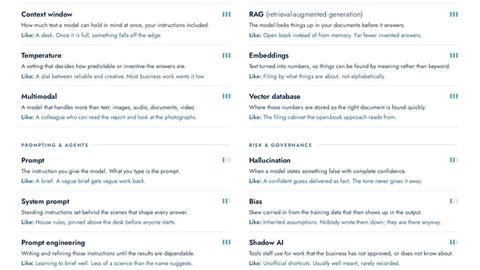
- RAG: retrieval-augmented generation; giving a model relevant passages from your own documents when it answers.
- Safetensors: a model file format that cannot run code when loaded, unlike formats based on Python’s pickle.
- Self-hosting: running a model on infrastructure you control, whether owned or rented.
- Serving engine: software that runs a model for many users at once, such as vLLM.
- Token: a chunk of text, roughly three-quarters of an English word, used to measure AI usage and pricing.
- Unified memory: memory shared by the processor and graphics chip, letting desktop machines hold large models.
- Zero data retention: a commitment that a provider does not store your prompts or outputs.
Where further research would help
- Independent, UK-specific benchmarks of open-weight models on legal, accounting and financial tasks.
- Real total cost of ownership data from SMEs running private AI, including people costs.
- Measured throughput and concurrency for desktop-class AI hardware on business workloads.
- How UK insurers, auditors and clients assess private versus public AI deployments.
- Energy use and carbon intensity of self-hosted versus cloud AI for small deployments.
- The security posture of self-hosted AI inside UK organisations, beyond internet-wide scans.
- How the open–closed capability gap behaves as benchmarks move to private test sets.
Related reading and future topics
On the Knowledge Hub
- You don’t need a Ferrari to buy the groceries: what China’s open-weight AI means for businesses
- You can’t govern what you can’t see: shadow AI, explained
- The EU AI Act after the Omnibus: what’s changed for UK firms
- The AI governance starter guide for mid-sized firms
- Ready for scrutiny: answering AI questions from clients, insurers and auditors
- Every tool you use has probably added AI in the last 12 months
Suggested topics for future articles
- How to evaluate an open-weight model on your own data: a step-by-step guide
- Private AI for law firms: meeting the SRA’s confidentiality expectations
- Data residency versus data sovereignty: the questions to ask every AI vendor
- Hardening a self-hosted AI server: a practical security checklist
- RAG explained: reliable answers from your own documents
- AI model licences compared: Apache 2.0, MIT and custom terms
- Interactive tool: API versus self-hosted AI cost calculator
- Small language models: when smaller is better
- Hybrid AI routing: sending each task to the right model
How TURMA helps
TURMA does not sell AI infrastructure, so we have no stake in which option you choose. We help you make the decision on evidence, then govern whatever you run. Snapshot shows what AI is already in use across your firm and where your data goes, which is the starting point for any private AI decision. Our governance tools keep your policies, AI register and evidence current whether your models run in the cloud or on your own servers, and Passport trains your people to use them safely.
See it. Control it. Prove it.
Sources
All links accessed in November 2026. Sources marked “vendor” are produced or sponsored by a company with a commercial interest in the findings.
- [1] Stanford HAI — The 2026 AI Index Report: Technical Performance (April 2026)
- [2] Epoch AI — Open models lag state-of-the-art closed models by 4 months (29 May 2026)
- [3] Epoch AI — Open-weight models lag state-of-the-art by around 3 months on average (30 October 2025)
- [4] Epoch AI — What’s the best model you can run on a single consumer GPU? (August 2025)
- [5] Artificial Analysis — Recent open weights model launches (30 April 2026)
- [6] Cybernews — Artificial Analysis leaderboard update widens the open-weight gap (October 2026)
- [7] The Implicator — Artificial Analysis raises the bar for AI models (28 October 2026)
- [8] The Implicator — Stanford’s 2026 AI Index and Chinese labs’ move to closed flagships (13 April 2026)
- [9] OpenAI — gpt-oss-120b model card, Hugging Face (August 2025)
- [10] The Register — Google battles Chinese open-weights models with Gemma 4 (2 April 2026)
- [11] DeepLearning.AI, The Batch — Meta releases Wonder, opens Spark (October 2026)
- [12] The New Stack — Meta ships Muse Spark Open (October 2026)
- [13] Let’s Data Science — Mistral Large 4 weights released and licence terms (October 2026)
- [14] andrew.ooo — Mistral Large 4 open weights: licence, hardware and price (October 2026)
- [15] Open Source Initiative — The Open Source AI Definition 1.0 (presentation, 2025)
- [16] Gartner — By 2027, organisations will use small, task-specific AI models three times more than general-purpose LLMs (9 April 2025)
- [17] The Register — Nvidia debuts $4,999 DGX Spark with half the RAM, amid memory crunch (2026)
- [18] MacRumors — Mac Studio buyer’s guide: M5 Max vs M5 Ultra (2026)
- [19] MacDailyNews — Apple’s fully loaded Mac Studio costs $29,799 (29 October 2026)
- [20] 9to5Mac — Apple unveils new Mac Studio with M5 Max and M5 Ultra (August 2026)
- [21] GPUPrix — RTX PRO 6000 Blackwell UK price history (October 2026)
- [22] Uvik Software — GPU Price Index 2026 (October 2026, vendor)
- [23] IntuitionLabs — NVIDIA AI GPU pricing guide (revised 10 October 2026)
- [24] Cast AI — GPU cloud pricing (2026, vendor)
- [25] DigitalOcean — How KV caching slashes LLM inference costs at scale (1 June 2026)
- [26] Red Hat Developer — Ollama vs vLLM: a deep dive into performance benchmarking (8 August 2025)
- [27] Pan et al., Carnegie Mellon University — A cost-benefit analysis of on-premise LLM deployment, arXiv 2509.18101 (v3, November 2025)
- [28] IntuitionLabs — Hosted AI APIs vs self-hosted models: cost comparison (5 September 2026)
- [29] Epoch AI — LLM inference prices have fallen rapidly but unequally across tasks (March 2025)
- [30] Gundlach et al., MIT — The Price of Progress: algorithmic efficiency and the falling cost of AI inference, arXiv 2511.23455 (November 2025)
- [31] Morph — LLM API pricing 2026 (July 2026, vendor aggregator)
- [32] Catalyst Commercial — Business Energy Cost Index, Q1 2026, based on DESNZ Quarterly Energy Prices (30 June 2026)
- [33] Information Commissioner’s Office — Guidance on AI and data protection
- [34] Privacy Laws & Business — ICO updates AI plans for 2026/27 (2026)
- [35] BCLP — EMEA data privacy, digital and AI round-up, January to June 2026
- [36] The Register — Microsoft admits it ‘cannot guarantee’ data sovereignty (25 July 2025)
- [37] OpenAI — The next chapter for UK sovereign AI (22 October 2025)
- [38] Computer Weekly — Ministry of Justice’s OpenAI deal paves way to sovereign AI (October 2025)
- [39] Financial Conduct Authority — Building the future of finance in the age of AI, speech by Jessica Rusu (19 October 2026)
- [40] Eversheds Sutherland, Regulation Tomorrow — FCA good and poor practice: AI in financial services (October 2026)
- [41] PwC UK — FCA sets out responsible AI practice (October 2026)
- [42] Latham & Watkins — FCA issues guidance for firms on their use of AI (30 October 2026)
- [43] Baker McKenzie — FCA reinforces supervisory expectations for frontier AI (May 2026)
- [44] Law Society Gazette — SRA looking into dozens of reports of AI misuse (August 2026)
- [45] HSF Kramer — Solicitors Regulation Authority issues a warning notice on the misuse of AI (2026)
- [46] Software Improvement Group — EU AI Act summary, updated for the Digital Omnibus (August 2026)
- [47] CMS — General-purpose AI models: obligations and roles for providers and downstream modifiers under the EU AI Act
- [48] Hunton — UK publishes AI Cyber Security Code of Practice and implementation guide (February 2025)
- [49] AI Standards Hub (DSIT) — Working towards a European baseline for secure AI: EN 304 223
- [50] SecurityWorldMarket — ETSI releases global EN standard for securing AI (2026)
- [51] Modulos — OWASP Top 10 for Large Language Model Applications (2025), summary of the OWASP GenAI Security Project list
- [52] SentinelOne SentinelLABS — Silent Brothers: Ollama hosts form anonymous AI network beyond platform guardrails (January 2026, vendor)
- [53] The Hacker News — Researchers find 175,000 publicly exposed Ollama AI servers across 130 countries (January 2026)
- [54] TechInformed — Open-source LLMs are forming an exposed internet compute layer, researchers warn (2026)
- [55] Cisco — Detecting exposed LLM servers: a Shodan case study on Ollama (2025, vendor)
- [56] Cloud Security Alliance — Model hub typosquatting: malicious AI in enterprise pipelines (12 May 2026)
- [57] The Hacker News — Malicious ML models found on Hugging Face use broken pickle files to evade detection (February 2025)
- [58] Bloomberg — Samsung bans staff’s AI use after spotting ChatGPT data leak (2 May 2023)
- [59] Business Standard (Bloomberg) — Samsung bans employees from using AI after spotting ChatGPT data leak (2 May 2023)
- [60] Wu et al., Bloomberg — BloombergGPT: a large language model for finance (30 March 2023)
- [61] Li et al., Queen’s University and J.P. Morgan AI Research — Are ChatGPT and GPT-4 general-purpose solvers for financial text analytics? EMNLP 2023
- [62] Travers Smith — Travers Smith launches innovative open sourced YCNBot (2023)
- [63] Legal IT Insider — Travers gives green light for AI team to forge breakaway company (2024)
- [64] Department for Business and Trade — Using self-hosted large language models securely in government (9 July 2025)
- [65] HSBC — HSBC and Mistral AI join forces to accelerate AI adoption across global bank (1 December 2025)
- [66] Financial Times, via Latham & Watkins — Latham buys Nvidia servers to set up in-house AI systems (10 September 2026)
- [67] City AM — Elite law firm to splash £370m on building own AI tool (28 May 2026)
- [68] Office for National Statistics — Artificial intelligence in UK businesses: 2023 to 2026 (July 2026)
- [69] Office for National Statistics — Business insights and impact on the UK economy (8 October 2026)
- [70] Broadcom — Private Cloud Outlook 2026: the AI tipping point (9 June 2026, vendor)
- [71] Cloudian — Enterprise AI Infrastructure Survey 2026 (March 2026, vendor)
- [72] Dataconomy — Menlo Ventures mid-2025 LLM market update (4 August 2025; Menlo is an Anthropic investor)
- [73] Meta — Meta backs $1 million initiative to get UK’s best AI talent to build tech for public services (July 2025, vendor)
Frequently asked questions
What is private AI?
Private AI is AI where your organisation controls where data is processed, who can access it and which model runs. It ranges from enterprise AI services with UK data residency, through dedicated cloud hosting, to open-weight models running on servers you own.
Is running our own AI cheaper than using an API?
Usually not for smaller firms once staff costs are included. In our illustrative model, a single self-hosted GPU server only matched a frontier API at about 235 million tokens a month, and would need billions of tokens a month to match a budget hosted API. The stronger case for self-hosting is control, confidentiality and predictable costs.
Can a small business run its own AI model?
Yes, for defined tasks such as searching and summarising its own documents. A single workstation or a dedicated cloud GPU can serve a capable open-weight model to a small team, provided it is secured properly and someone owns it day to day.
Does self-hosting AI make us GDPR compliant?
No. Self-hosting changes who processes the data, but you still need a lawful basis, transparency, appropriate security and a data protection impact assessment where required. It can simplify supplier due diligence and international transfer questions.
Should we train our own AI model?
Almost never. Connecting a capable existing model to your own documents through retrieval, and fine-tuning only for narrow tasks, delivers most of the value at a fraction of the cost and risk.